
Trailing Drawdown Explained: Daily Loss vs Max Loss in Funded Accounts
Trailing drawdown is one of the most confusing rules in funded trading.
Many Indian traders pass profit targets easily, but lose account access or fail evaluations because they misunderstand one simple thing:
Loss limits are not suggestions. They are the entire system.
In this guide, we will explain:
- What trailing drawdown actually means
- How it differs from fixed drawdown
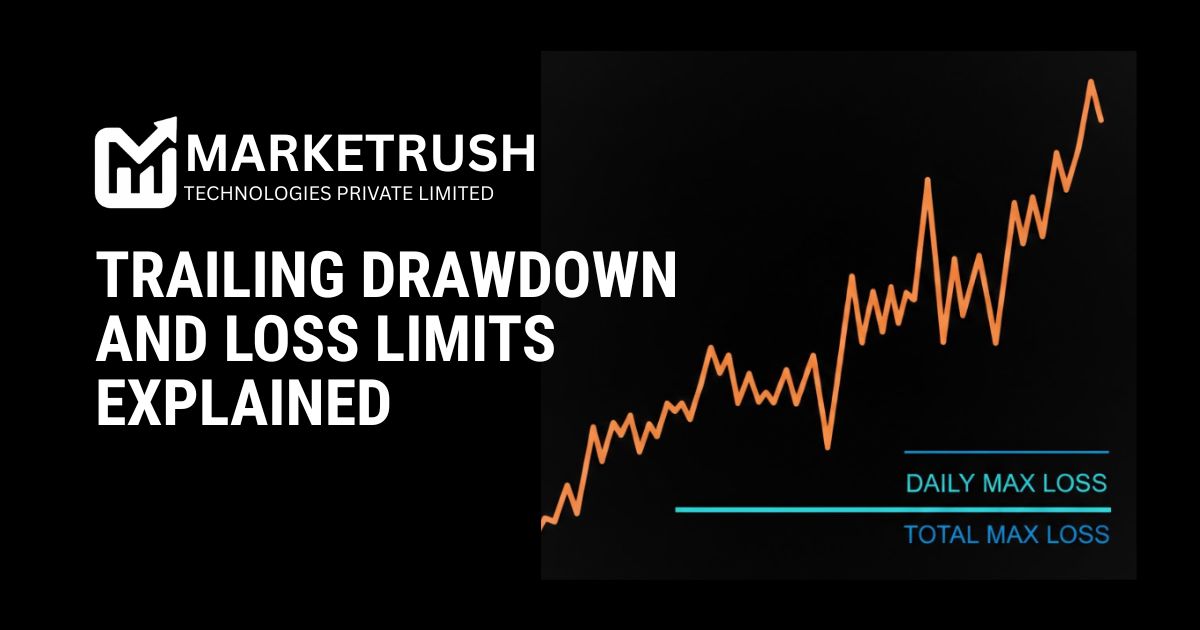
- The difference between max daily loss and max total loss
- Why FNO traders fail these rules so often
- How to trade safely inside drawdown limits
What Is Drawdown in Funded Trading?
Drawdown is the maximum loss allowed before your account fails.
Funded accounts are not about making the most profit.
They are about proving:
- Risk control
- Discipline
- Survival through volatility
Drawdown is how firms measure that discipline.
Fixed Drawdown vs Trailing Drawdown (Important Difference)
Most Indian index evaluation platforms use fixed drawdown, but many global prop firms use trailing drawdown.
Understanding the difference matters.
Fixed Drawdown (Simpler)
Fixed drawdown means:
- Your maximum loss limit stays constant
- It is usually calculated from your starting balance
Example:
- Starting balance: ₹1,00,000
- Max loss allowed: ₹10,000
Your account fails if equity drops below:
₹90,000
That limit does not move.
Trailing Drawdown (More Strict)
Trailing drawdown means:
- The loss limit moves upward as you make profits
- Your “floor” rises with your account high
Example:
- Starting balance: ₹1,00,000
- Trailing drawdown: ₹10,000
If you grow the account to ₹1,10,000…
Now the drawdown floor becomes:
₹1,00,000
So even after making profit, you can still fail quickly if you give back too much.
Trailing drawdown is why many traders feel they “passed profit but still lost the account.”
The Two Rules That Matter Most: Daily Loss vs Total Loss
Most traders confuse these.
They are completely different.
Max Daily Loss (Daily Stop Rule)
Max daily loss is the biggest amount you can lose in a single day.
This rule exists because one emotional session destroys most traders.
Example:
- Max daily loss: ₹2,000
Program outcomes vary. On Market Rush, reaching the daily limit cancels pending orders, squares open positions, and permanently fails the account. Max Total Loss is also a permanent account-failure limit.
It does not matter if:
- You were profitable yesterday
- You are close to the profit target
- You “just need one trade back”
Daily loss limits prevent revenge trading.
Why Indian Traders Reach Daily Loss Often
NIFTY, BANKNIFTY and SENSEX are highly volatile intraday.
Common failure patterns:
- Overtrading after a losing morning
- Expiry-day spikes
- Doubling position size to recover
- Ignoring stop-loss discipline
Repeated daily locks leave the realised losses on the account and can quickly reduce the remaining buffer before the permanent Max Total Loss boundary.
Max Total Loss (Overall Drawdown Rule)
Max total loss is the maximum loss allowed across the entire account lifecycle.
It is your final risk boundary.
Example:
- Starting balance: ₹1,00,000
- Max total drawdown: ₹10,000
Account fails if equity hits:
₹90,000
This rule measures long-term consistency, not one bad day.
Daily Loss vs Total Loss (Simple Truth)
- Daily loss protects the firm from one impulsive day
- Total loss protects the firm from slow uncontrolled drawdowns
Professional traders respect both.
Common Funded Account Risk Rules (India)
| Rule Type | What It Means |
|---|---|
| Max Daily Loss | The biggest loss allowed in a single trading day. Often the fastest way traders fail. |
| Max Total Loss (Drawdown) | The overall account loss limit. If breached, the evaluation or funded stage ends. |
| Fixed Drawdown | A constant loss limit based on starting balance. Common in India-focused evaluations. |
| Trailing Drawdown | A moving loss limit that rises with profits. Easy to violate if misunderstood. |
| Minimum Trading Days | Requires consistency across multiple days instead of passing with one lucky session. |
| Expiry / Instrument Restrictions | Some platforms restrict weekly expiry trading or certain option strategies due to volatility. |
Why Trailing Drawdown Is So Dangerous on NIFTY
NIFTY options can swing rapidly.
A trader might:
- Make ₹8,000 in two days
- Feel confident
- Then lose ₹5,000 in one expiry spike
With trailing drawdown, that loss may violate the moving floor immediately.
Trailing drawdown punishes large profit givebacks.
It rewards stable equity curves, not excitement.
How to Trade Safely Within Loss Limits
If you want to survive funded evaluations, follow these principles:
1. Treat Daily Loss as a Hard Stop
If you are down 60–70% of the daily limit:
Stop trading.
Most failures happen in the last few trades of the day.
2. Size Positions for Volatility, Not Emotion
The market does not care about your confidence.
Trade small enough that one candle cannot destroy your account.
3. Avoid Expiry Overtrading
Expiry sessions create false urgency.
Many traders fail evaluations not because of strategy, but because of expiry impulsiveness.
4. Focus on Staying Funded, Not Passing Fast
Fast passes often come from oversized risk.
The best traders pass slowly, consistently, and repeatably.
How Market Rush Approaches Risk Rules for Indian Traders
Market Rush is designed specifically for Indian index traders.
It focuses on:
- NIFTY / BANKNIFTY / SENSEX instruments
- Fixed, transparent drawdown frameworks
- Rule clarity over marketing hype
- Evaluation models built around Indian volatility realities
The goal is simple:
Reward discipline, not gambling.
Final Thoughts: Drawdown Rules Are the Real Evaluation
Most traders think funded accounts test strategy.
In reality, they test:
- Risk control
- Emotional discipline
- Ability to survive volatility
If you understand max daily loss and max total loss clearly, you already have an edge.
Because funded trading is not about prediction.
It is about protection.
Related articles
How Order Fills Work: Market Depth, Bid/Ask Liquidity & Slippage
Learn how buy and sell orders are filled from market depth, why larger orders execute at multiple prices, and how slippage is created and calculated.
23 Aug 2026
PaperTradingApp Review: Best App to Practice Trading Free
Master trading before risking real money. Read our PaperTradingApp review and start practicing free with real-time market data today.
20 Aug 2026
Nifty Prop Firm Checklist: 9 Questions to Ask Before You Pay Anything
Most Indian traders evaluate prop firms on profit split and account size alone. This checklist covers the nine questions that actually determine whether a funded account is worth your time and money.
08 Mar 2026
All information provided on this site is intended solely for educational purposes related to financial markets and does not serve as investment advice or recommendations. Market Rush provides evaluation and educational tools only and does not act as a broker, investment adviser, or deposit-taking platform. Guest articles, reviews, and other third-party contributions reflect the views, claims, and opinions of their respective authors or contributors and do not necessarily represent the views, endorsement, or independent assessment of Market Rush.